LKFS vs LUFS: Same Loudness Idea, Two Labels
LKFS and LUFS name the same loudness-unit family used with ITU-R BS.1770.
Upload your track
Drop your finished mix here to get started.
EBU R 128 states that “LUFS” is equivalent to “LKFS”. Upload a mix to read integrated loudness labelled LUFS on this site.
Upload only audio you own or have permission to process. See Terms and Privacy.
In short
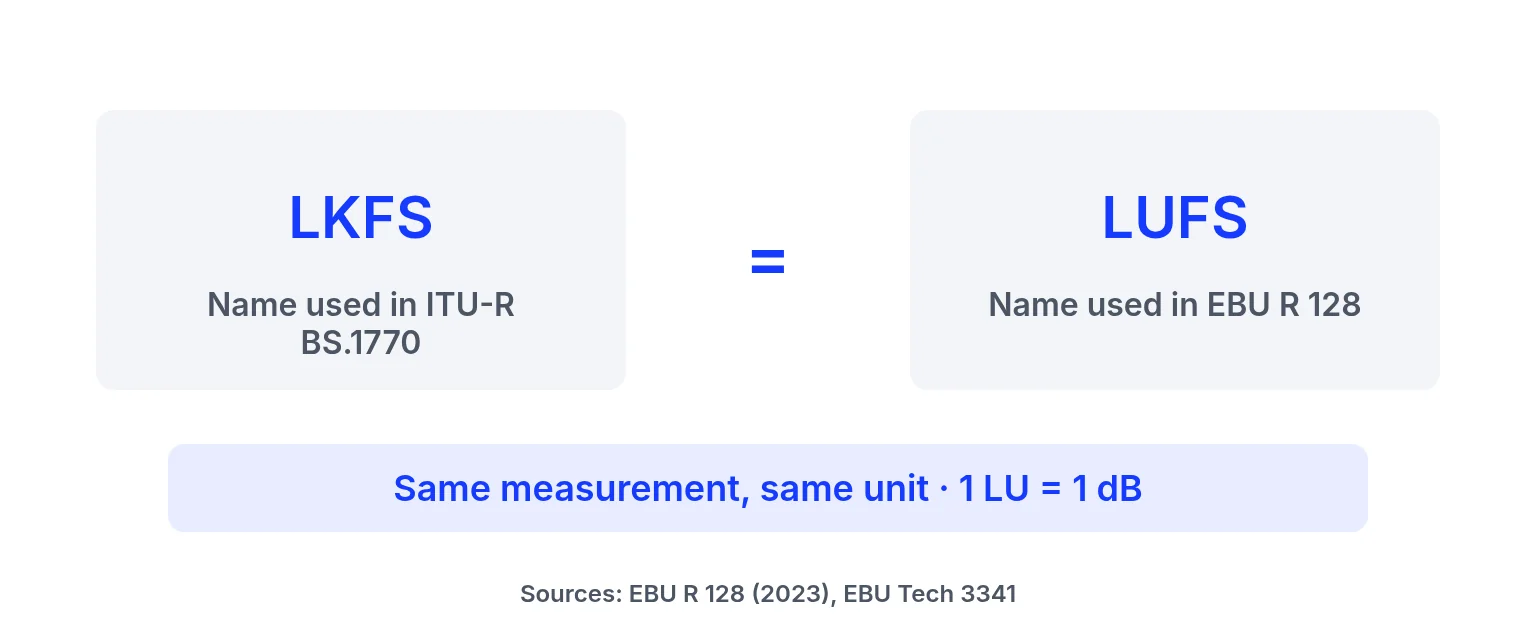
LKFS vs LUFS is a naming question, not a hidden second scale. ITU-R BS.1770 defines algorithms to measure audio programme loudness and true-peak audio level and uses the LKFS label in that family of documents. The EBU’s R 128 recommendation prefers the spelling LUFS and says explicitly that LUFS is equivalent to LKFS. Meters and DAWs may print either abbreviation; they are pointing at the same loudness concept when they follow BS.1770.
Where each name shows up
- LKFS appears in ITU-R BS.1770 materials (Loudness, K-weighted, relative to Full Scale — the expansion you will see in secondary explainers; trust the ITU/EBU documents for normative wording).
- LUFS appears in EBU R 128 and related EBU Tech documents used heavily in European broadcast.
- Music tools and streaming articles often say LUFS even when they cite BS.1770.
What is not different
| Claim you might hear | Reality from the standards |
|---|---|
| “LUFS is European, LKFS is American, so numbers disagree” | EBU R 128 treats the names as equivalent to the ITU unit |
| “You must convert LUFS to LKFS with a formula” | No conversion factor is defined for renaming the same reading |
| “1 LUFS ≠ 1 LKFS” | Equivalence means you do not apply an offset just to change the letters |
Relative loudness steps still use LU, and EBU Tech 3341 notes that 1 LU is equivalent to 1 dB. For how loudness differs from peak level in dBFS, read LUFS vs dB.
How this site labels the meter
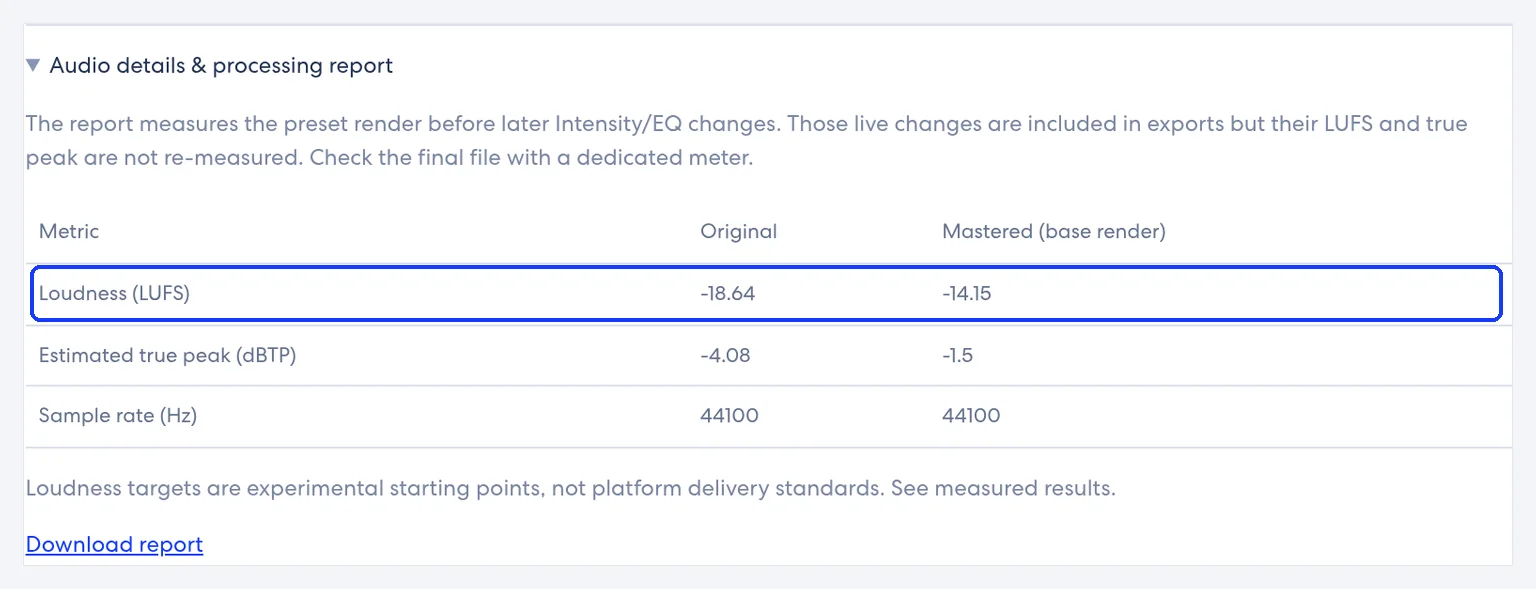
The studio report prints Loudness (LUFS). The measurement path uses an open-source BS.1770-4 implementation in the engine. True peak is estimated. The report measures the preset base render; later Intensity and EQ are included in exports but not re-measured here. None of that creates a separate “LKFS mode” — if another meter shows LKFS on the same algorithm family, compare readings with the same gating and file, not by renaming alone.
Practical checklist when docs disagree on the letters
1. Check which standard the author cites. BS.1770, EBU R 128, or a platform help page.
2. Compare integrated loudness on the same file in two meters before assuming a unit bug.
3. Do not invent platform targets. Use each platform’s own page via the streaming table.
4. Broadcast −23.0 LUFS in EBU R 128 is a programme target for broadcast, not an automatic music-streaming goal.
How to measure in 3 steps
Upload your finished mix
WAV, MP3, FLAC or AIFF, up to 200 MB and 10 minutes.
Read Loudness (LUFS)
Open the processing report under the player for Original and Mastered.
Cross-check only with known meters
If a delivery spec says LKFS, treat it as the same loudness family unless the spec defines a different method. Preview mastering free; song credits unlock downloads.
LKFS or LUFS on a delivery checklist
When a distributor or broadcast house writes LKFS on a form and your meter prints LUFS, you are usually looking at the same loudness family. Confirm three things before you argue about a conversion:
- The citation is ITU-R BS.1770 or EBU R 128, not a proprietary loudness mode with different gating.
- You are comparing integrated loudness on the same rendered file, not a short loop against a full song.
- True-peak ceilings are listed separately (dBTP), so you do not treat a loudness number as a peak limit.
If two meters still disagree after that, the gap is almost always implementation detail — windowing, gating, or file versions — not a hidden LUFS-to-LKFS formula. For music streaming, prefer each platform’s own help page via the streaming targets table rather than forcing every song to the broadcast −23.0 LUFS programme level.
Difference between LKFS and LUFS in everyday DAW talk
Producers often ask for the difference between LKFS and LUFS after seeing both spellings in plugins. In everyday talk there is no creative difference: pick a BS.1770-compliant integrated reading and stay consistent across an album. Relative moves still use LU. Absolute targets still sit on an absolute scale relative to full scale. What changes song to song is arrangement and limiting, not whether the label on the needle says LKFS or LUFS.
The honest limits
- This page does not redefine ITU or EBU text. Quotes follow the public PDFs.
- Meters can still disagree because of gating implementation, file versions or true-peak methods — not because LUFS and LKFS need a conversion chart.
- Estimated true peak here is not a certified meter claim.
- Preview free; downloads need song credits.
LKFS vs LUFS FAQ
Are LKFS and LUFS the same?
EBU R 128 states that LUFS is equivalent to LKFS as used in ITU-R BS.1770. Treat them as the same loudness-unit family when both follow that recommendation.
Why do some manuals say LKFS and others LUFS?
ITU-family documents use LKFS; EBU R 128 prefers LUFS while declaring equivalence.
Do I need to convert my LUFS reading to LKFS?
Not for renaming alone. If a delivery spec cites BS.1770 loudness, compare method and gating, not the three letters.
What does this site display?
Loudness (LUFS) and Estimated true peak (dBTP) in the processing report.
Is −23 LUFS a music streaming target?
That figure is EBU R 128’s broadcast programme target. Streaming platforms publish their own statements — see the streaming table.
What about LU versus LUFS?
LU is a relative loudness step; LUFS is an absolute loudness level relative to full scale. Tech 3341 equates 1 LU with 1 dB in size.
Does Apple Music use LKFS or LUFS?
Apple’s stereo Sound Check materials describe loudness normalization without printing a single consumer LUFS/LKFS target on the pages we cite for stereo playback.
Can I measure for free?
Yes. Upload and read the report while you preview masters.
Where should I go to understand peaks versus loudness?
Read LUFS vs dB for dBFS and true peak versus integrated loudness.
Ready to read loudness on your mix?
Upload above and use the LUFS reading as the same loudness family delivery specs call LKFS. → AI music mastering
Last updated: 2026-11-09