LUFS vs dB: Loudness Units Versus Digital Level
LUFS answers how loud a song feels over time. dB and dBFS answer how large a sample or peak is.
Upload your track
Drop your finished mix here to get started.
Upload a mix to read integrated loudness and estimated true peak side by side.
Upload only audio you own or have permission to process. See Terms and Privacy.
In short
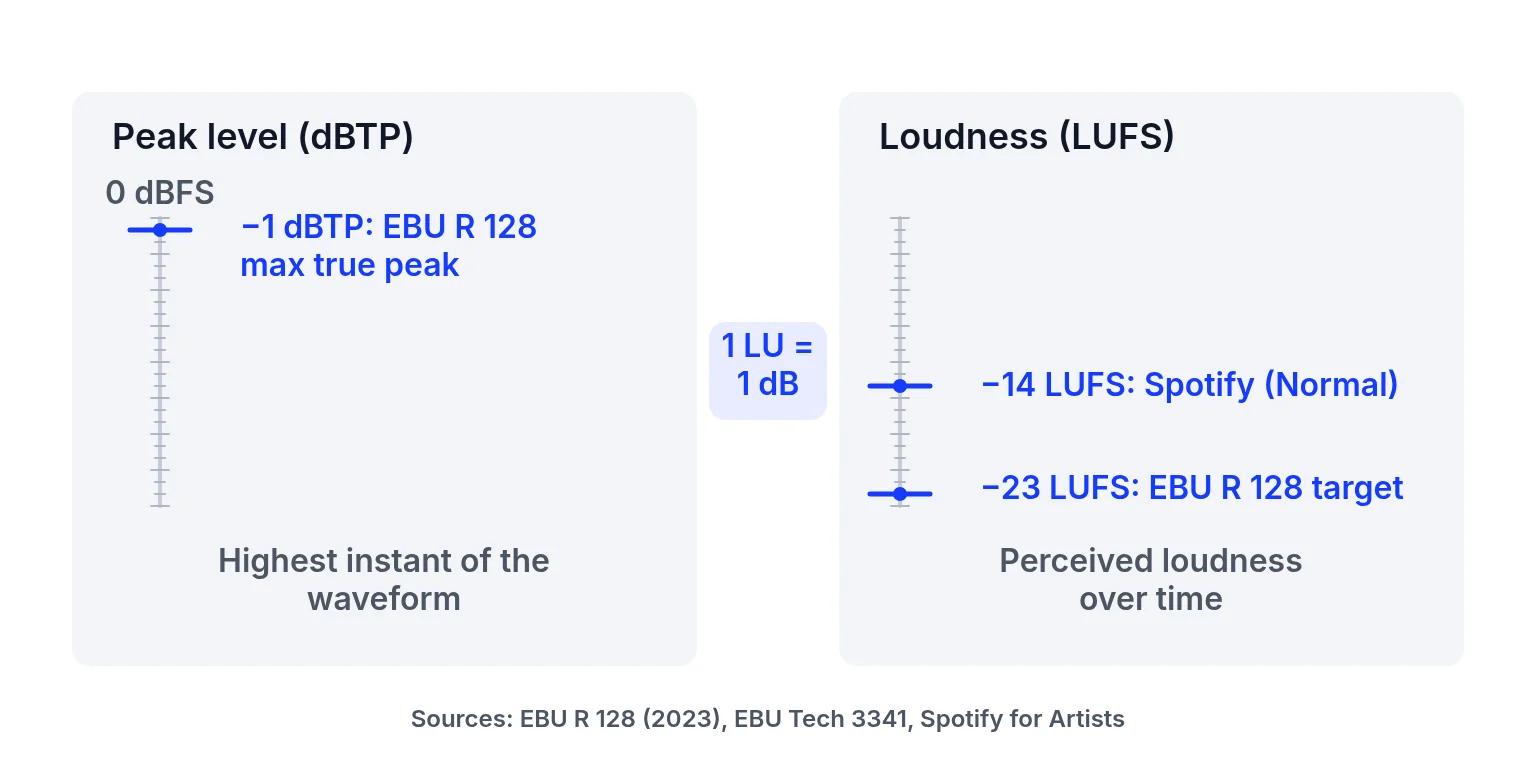
LUFS vs dB is a comparison of two different measurements. LUFS (Loudness Units relative to Full Scale) comes from loudness algorithms aligned with ITU-R BS.1770, which is titled for programme loudness and true-peak level. A dB figure on a DAW meter is often sample peak or RMS in dBFS, not the same gated loudness reading. EBU Tech 3341 notes that 1 LU is equivalent to 1 dB in size, which is why people confuse the units — equal step size does not make the measurements interchangeable.
What LUFS measures
LUFS is a loudness unit. Broadcasters and many music tools use integrated loudness over a whole programme or song, with gating so long silence does not drag the average down. EBU R 128 states that “LUFS” is equivalent to “LKFS” as used in ITU-R BS.1770, and sets a programme target of −23.0 LUFS for broadcast — a broadcast rule, not a Spotify number. Momentary loudness uses a 0.4 s window and short-term uses 3 s, per EBU Tech 3341.
On this site the report’s Loudness (LUFS) column is integrated loudness of the uploaded file (Original) and of the base mastered render (Mastered). Later live Intensity and EQ changes play in the export but are not re-measured in that report. True peak is an estimate, not a certified delivery meter reading. Details live on the LUFS meter page.
What dB and dBFS measure
A decibel (dB) is a relative level. In a digital audio workstation, 0 dBFS is full scale: the highest sample value the file format can hold. Peaks approaching 0 dBFS leave little headroom. Apple’s Digital Masters guide warns that pushing past 0 dBFS causes distortion and loss of dynamic range, and it recommends leaving at least 1 dB of headroom in a master.
dB alone always needs a reference. dBFS is relative to full scale. dBTP is true-peak level, which includes inter-sample peaks. Loudness in LUFS is also referenced to full scale in the name, but the number comes from a weighted, gated loudness algorithm — not a single sample peak.
LUFS vs dB side by side
| LUFS (loudness) | dB / dBFS (level) | |
|---|---|---|
| Question it answers | How loud does this programme feel over time? | How large is this sample, peak or gain change? |
| Typical music use | Integrated loudness of a song or album | Peak meters, fader moves, headroom |
| Standard reference | ITU-R BS.1770 family; EBU R 128 uses LUFS | Full scale (dBFS) for digital peaks |
| Step size note | 1 LU ≡ 1 dB (EBU Tech 3341) | 1 dB is one decibel of level |
| Can look “hot” while sounding quiet? | A dynamic mix can read moderate LUFS with high peaks | A limited file can sit near 0 dBFS and still measure moderate loudness after gating |
Why the same song can disagree
A mix with tall drum peaks can hit near 0 dBFS while its integrated LUFS stays relatively quiet, because loudness averages over time with gating. A heavily limited mix can sit close to full scale and also read loud in LUFS. Streaming services that normalize playback care about loudness, not about who won the peak race — see loudness normalization and the streaming LUFS targets table for what each platform publishes.
How to read LUFS vs dB on your mix in 3 steps
Upload the finished stereo file
Drop a WAV, MP3, FLAC or AIFF up to 200 MB and 10 minutes. Use the mix you plan to release, not a solo stem.
Open the processing report
Expand “Audio details & processing report” under the player. Read Loudness (LUFS) and Estimated true peak (dBTP) for Original and Mastered.
Decide with both numbers
If peaks are near full scale but the song still feels quiet, you may need mix balance or dynamics work before chasing loudness. If LUFS is already high and peaks are crushed, a louder master may only be turned down on streaming. Preview profiles free; unlock downloads with song credits when you want a file.

Common mix-ups
- Treating peak dBFS as loudness. Peaks do not equal perceived loudness.
- Aiming every song at a single dB peak. Streaming tables and broadcast targets talk loudness and true peak separately.
- Assuming 1 LUFS change always equals a 1 dB fader move on one track. Integrated loudness reacts to the whole programme after weighting and gating.
- Trusting MP3 meters alone. Encode after you check a lossless master when you can.
The honest limits
- This studio’s true peak is estimated with four-times oversampling in the engine notes; it is not billed as a certified true-peak meter.
- Report numbers describe the base render. Live Intensity/EQ after that are in the export but not re-measured here.
- No platform target is invented on this page. Use the streaming table for published figures.
- Preview free; downloads need song credits ($1.99 USD once for 5 songs, no automatic renewal).
LUFS vs dB FAQ
What is the difference between LUFS and dB?
LUFS measures perceived loudness over time with a standardised algorithm. dB or dBFS describes relative level or digital peak. They answer different questions.
Is 1 LU the same as 1 dB?
EBU Tech 3341 states that 1 LU is equivalent to 1 dB. That equal step size does not make integrated loudness the same as a peak meter reading.
What is dBFS?
Decibels relative to full scale. 0 dBFS is the maximum sample value in a digital file.
What is dBTP?
True-peak level, including peaks between samples. Streaming advice often quotes true-peak ceilings separately from LUFS targets.
Should I master to a dB peak or to LUFS?
Use both: leave peak headroom and check integrated loudness against what your release platforms publish.
Does this site show LUFS and peaks?
Yes. The processing report lists Loudness (LUFS) and Estimated true peak (dBTP).
Is LUFS the same as LKFS?
EBU R 128 says LUFS is equivalent to LKFS as used in ITU-R BS.1770. See LKFS vs LUFS.
Can a louder peak make streaming play me quieter?
On services that normalize, a louder loudness reading can be turned down. Peak height alone is not the whole story.
Is measuring free?
Yes. Upload and read the report while you preview. Downloads need song credits.
Ready to compare loudness and peaks?
Upload your mix above and read LUFS next to estimated true peak before you decide on a master. → AI music mastering
Last updated: 2026-11-09